
Last Updated: October 28, 2026
Quick Summary
Camping with kids in remote in Australia is hard work but worth the effort, because a quiet bush campsite teaches children things a resort never will. You will do more planning and pack more carefully than a city holiday, so practice with short camps close to home first.
- Book one or two short practice camps at a family-friendly campground within an hour of the city.
- Work through a remote camping checklist covering vehicle servicing, fuel, water, paper maps and permits.
- Pack baby wipes in bulk, layers, wide-brim hats, head torches and snacks that don’t melt or spoil.
- Assign one adult as designated watcher near water, fire and vehicles, and rotate the role.
- Carry a PLB registered with the Australian Maritime Safety Authority on the person, not in the vehicle.
Table of Contents
- Why Remote Camping With Kids Is Worth the Effort
- Practice Camping Before You Go Remote
- Your Remote Camping Checklist for Families
- The Camping With Kids Packing List (and What to Leave Behind)
- Camping With Toddlers: Age-Specific Advice for Little Ones
- Family Camping Safety Tips for Remote Areas
- Keeping Kids Entertained Off-Grid
- Enquire About a Family-Ready Camper for Your Remote Trip
- Frequently Asked Questions
Why Remote Camping With Kids Is Worth the Effort
Camping with kids in remote in Australia is hard work, and we won’t pretend otherwise. But it is also the kind of trip children remember for decades.
Here’s what most guides get wrong. They treat remoteness as a problem to manage rather than the whole point.
A quiet bush campsite teaches children things a resort never will. They learn to read the light for bedtime. They learn that water comes from a tank, not a tap. They learn patience on long gravel stretches.
The trade-off is real. You will do more planning than a city holiday. You will pack more carefully. But the payoff is a family rhythm that’s hard to find anywhere else.
Practice Camping Before You Go Remote
A common approach is one or two short practice camps close to home first.
Book a weekend at a family-friendly campground within an hour of the city. Pitch the tent or set up the camper. Cook outside. Sleep in the beds you’ll use on the real trip.
This gives kids a taste of camping overnight without the pressure.
Your Remote Camping Checklist for Families
Here’s a short remote camping checklist for families heading off the beaten track.
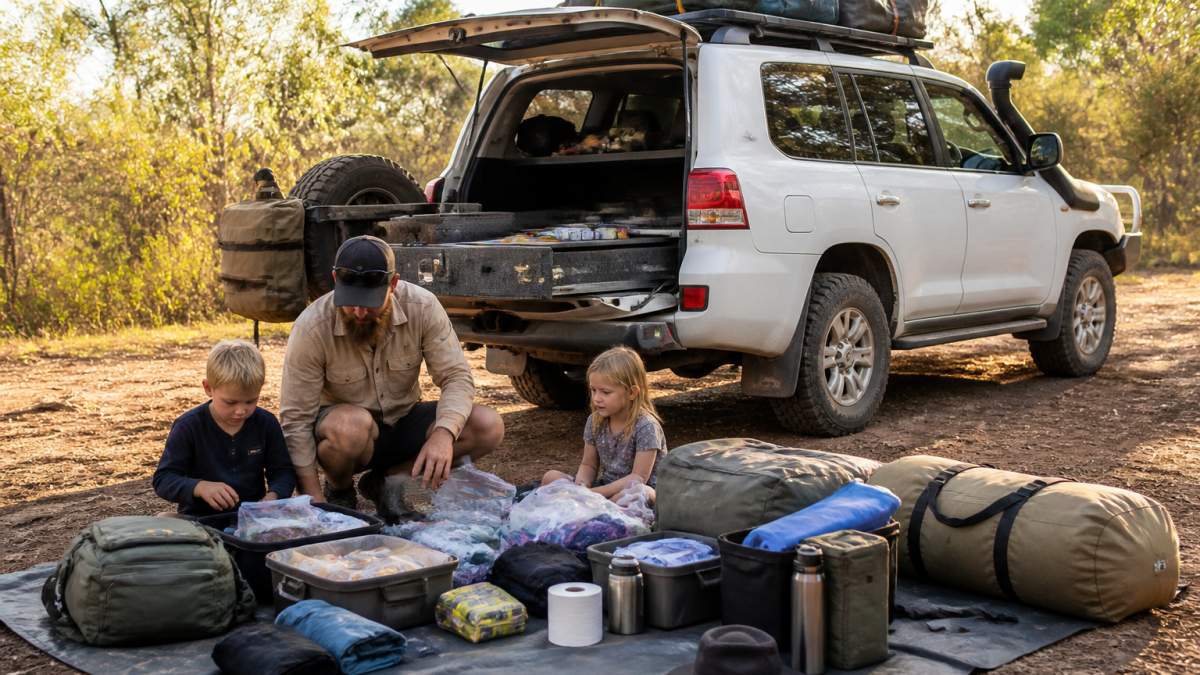
Work through these before you leave:
- Vehicle serviced and tyres checked, including the spare
- Long-range fuel sorted and water containers filled
- Paper maps and a backup navigation plan
- Emergency contact list printed, not just saved on a phone
- First aid kit stocked for adults and children
- Weather forecast checked for the whole route
- Campsite bookings or permits confirmed
- Food and supplies calculated with a buffer
The checklist isn’t glamorous. Our FAQ covers camper features, hire conditions and logistics that affect your family checklist.
The Camping With Kids Packing List (and What to Leave Behind)
Your camping with kids packing list can be concise.
Pack these essentials:
- Baby wipes in bulk, even for older kids
- Layers for cold nights and hot days
- Wide-brim hats and sunscreen
- Head torches for each child
- A small bag of favourite toys and books
- Refillable water bottles
- Snacks that don’t melt or spoil Ensuring a restful night after a long day of exploration requires choosing comfortable travel bedding that withstands the rugged conditions of the outback.
Camping With Toddlers: Age-Specific Advice for Little Ones
Children are not a single category. A baby, a toddler, and a ten-year-old may have different sleep, food, supervision, and activity needs on a remote trip.
Babies (under about 12 months)
- Sleep: bring a familiar portable cot or sleep sack and keep the routine as close to home as possible; expect disrupted nights and plan shorter driving days
- Feeding: pack formula, sterilising equipment, and expressed milk or food with a buffer; assume no resupply
- Supervision: babies cannot self-regulate temperature or hydration, so shade, layers, and frequent feeding are non-negotiable
- Remote considerations: avoid long stretches without a safe place to change and settle; a shaded, contained play area near the campsite is essential
Toddlers (roughly 1-3 years)
- Sleep: familiar blanket, earlier bedtime, and a consistent wind-down routine; a dark, quiet tent helps
- Food: simple, familiar food and frequent snacks; toddlers dehydrate quickly and may refuse unfamiliar food
- Supervision: constant line-of-sight near water, fire, and vehicles; set and walk a visible camp boundary
- Activity: short, sensory activities, collecting leaves, spotting birds, digging, work better than structured games
School-age children (roughly 4-12 years)
- Sleep: later bedtimes are fine, but keep a consistent routine; head torches and a book help
- Food: involve them in cooking and let them choose snacks within limits
- Supervision: give real jobs, collecting firewood, filling water bottles, checking the tent setup, and set clear rules for roaming
- Activity: wildlife journals, bush bingo, damper cooking, and stargazing keep them engaged and invested
Teenagers
- Sleep: give them their own space and some control over their setup
- Food: involve them in meal planning and cooking
- Supervision: agree on boundaries and check-in times rather than constant oversight
- Activity: navigation, photography, and trip planning roles give them ownership
Assign one adult as the designated watcher near water, fire, and vehicles at all times, and rotate the role so no one is supervising constantly. Brief older children on what to do if a younger sibling wanders off.
Child supervision is important.
Each age group needs a different approach to sleep, food, supervision and activity on a remote trip.
| Age group | Sleep | Food | Supervision and activity |
|---|---|---|---|
| Babies (under about 12 months) | Portable cot or sleep sack, routine close to home | Formula, sterilising equipment, buffer supplies | Shade, layers, frequent feeding; contained play area |
| Toddlers (roughly 1-3 years) | Familiar blanket, earlier bedtime, dark quiet tent | Simple familiar food, frequent snacks | Constant line-of-sight near water, fire, vehicles; short sensory activities |
| School-age children (roughly 4-12 years) | Consistent routine, head torches and a book | Involve them in cooking, let them choose snacks | Real jobs and clear roaming rules; journals, bush bingo, damper, stargazing |
| Teenagers | Own space and control over their setup | Involve them in meal planning and cooking | Agreed boundaries and check-in times; navigation, photography, trip planning |
Family Camping Safety Tips for Remote Areas
Remote safety is not a longer version of campground safety. Our travel info archives offer deeper travel information and practical guidance for remote-area trips with the family. It is a different discipline. These are family camping safety tips built around that reality.
Communications: assume no mobile coverage
Do not plan around phone signal. In many remote areas it disappears for tens of kilometres at a time. A family setup to consider includes:
- A satellite messenger or personal locator beacon (PLB) registered with the Australian Maritime Safety Authority, carried on the person, not left in the vehicle
- A second communication method where possible (satellite phone, HF radio, or a second messenger)
- A printed emergency contact list, including the nearest police station and the relevant state or territory parks office
- A written route plan left with a responsible contact, with a check-in schedule and an agreed trigger for raising the alarm
A PLB is for genuine life-threatening emergencies. Use a satellite messenger for routine check-ins and non-emergency coordination so the emergency channel stays clear.
First aid and injury response for children
Stock a first aid kit for the whole family and know how to use it on a child, not just an adult. Priorities in a remote setting:
- Control bleeding and treat burns first, campfires and cooking equipment are the most common serious injuries on family trips
- Treat dehydration and heat illness early; children dehydrate faster than adults and may not recognise the symptoms
- Carry children’s paracetamol or ibuprofen in age-appropriate doses, plus any prescription medication with a buffer
- Know the location of the nearest hospital or medical facility before you leave, and how long it takes to reach it
Separation and supervision
Agree on rules before you arrive:
- Set a visible camp boundary and walk it with the children
- Use a whistle per child and teach a three-blast response
- Dress children in bright colours and take a photo each morning in what they are wearing
- Assign one adult as the designated watcher near water, fire, and vehicles at all times
- If a child goes missing, search the immediate camp and last known location first, then call for help early rather than late
Australia-specific hazards and seasonal conditions
Remote hazards are seasonal and regional.
- Heat and dehydration: avoid peak afternoon activity, carry more water than you estimate, and treat water supplies as finite
- Fire: check fire danger ratings and total fire bans before and during the trip via official bushfire and weather warnings; know your evacuation route
- Flood and road closure: check road conditions with the relevant state road authority before committing to remote tracks; creek crossings can rise fast
- Wildlife and insects: store food securely, shake out boots and bedding, and carry insect repellent and a snake bandage
- Distance and fuel: plan fuel range with a buffer and identify resupply points in advance
A remote safety habit to consider is a pre-trip briefing: route, check-in schedule, emergency contacts, and what each family member does if something goes wrong. Run it with the children, not just the adults.
Keeping Kids Entertained Off-Grid
Try these children’s activities:
- Wildlife spotting journals with a simple checklist
- Bush bingo with local plants and birds
- Cooking damper over the fire
- Star gazing after dark
- Rock pooling or beachcombing near riverside camping and beach camping spots
Enquire About a Family-Ready Camper for Your Remote Trip
If you’re weighing up options, browse our camper range.
When you’re ready, you can submit an enquiry.
Frequently Asked Questions
How do you prepare children for camping in a remote area?
Start with a practice camping trip close to home. Talk through what a remote campsite will be like, including no phone signal and limited water. Involve children in packing their own gear.
How much water should a family take on a remote camping trip?
As a working rule, allow at least 4 to 5 litres per person per day for drinking, cooking and basic hygiene, and more in hot weather or if you have toddlers. A family of four on a week-long remote camping trip should plan for well over 100 litres, plus a reserve. Carry water in several containers rather than one large tank, and check whether your campsite has any potable supply before you leave the last town. Long-range fuel tanks and extra jerry cans help, but water is the supply families run out of first.
What should families do if their vehicle breaks down in a remote area?
Stay with the vehicle, because it is easier to find than a person on foot, and it provides shade and shelter. Carry a personal locator beacon or satellite messenger, since phone signal is unreliable in remote camping areas. Tell someone your itinerary before you leave and stick to it. Keep a basic toolkit, spare tyre, jumper leads and extra water and food in the vehicle. If you are renting, confirm the provider’s roadside assistance arrangements and maintenance schedule before you depart so you know exactly who to call.
What age is suitable for taking children on a remote camping trip?
There is no fixed age, but most families find remote camping with toddlers workable from around two to three years old, once a child can walk steadily and sleep through the night reasonably well. Babies can travel too, but they need more shade, sterilising gear and a strict water and temperature plan. Older children from about six upwards can help with camp tasks and cope better with long drives. The real deciding factor is your family’s experience level, so build up with shorter trips before heading somewhere truly secluded.
Remote camping with kids in remote Australia rewards the families who prepare well. It asks for practice camps, a solid checklist, and a reliable vehicle. Bonito Camper can help with the last part: well-equipped 4WD campers, long-range fuel tanks, and a complimentary park pass for unlimited entry to Western Australia’s parks. Get started with Bonito Camper and plan a remote family trip you’ll talk about for years.
