
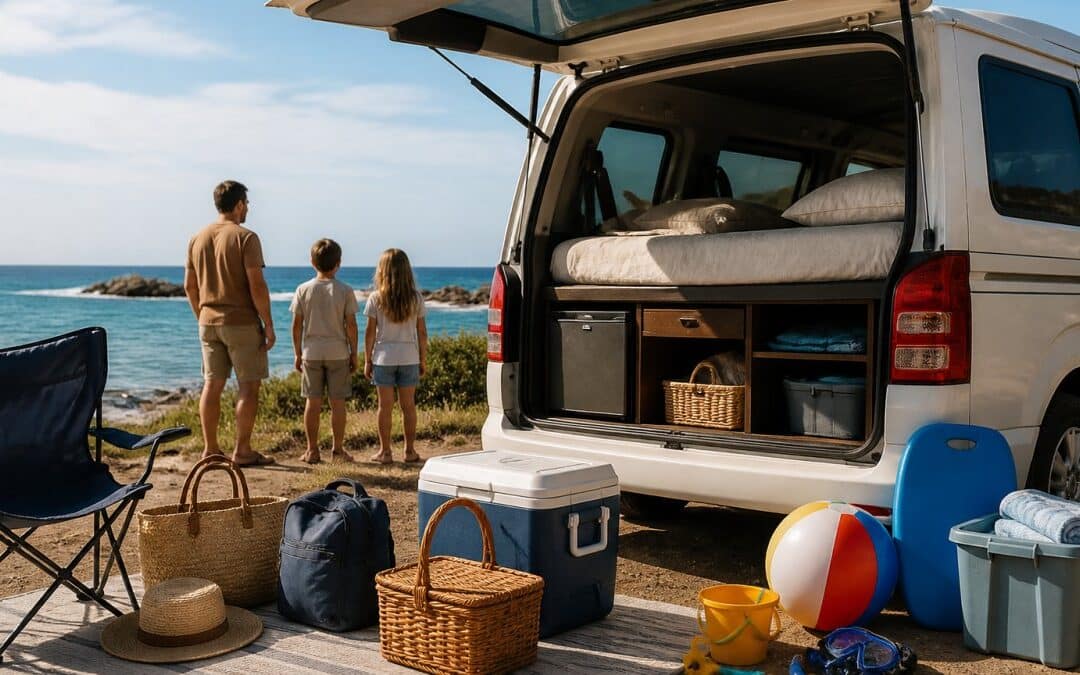
Last Updated: October 23, 2026
Quick Summary
Family friendly campervan hire in Western Australia puts your family’s beds, kitchen and gear in one vehicle that moves when you do, cutting daily logistics. Match the vehicle to your family, confirm child restraints and anchor points in writing, and plan driving days of three to four hours with buffer days built in.
- Confirm the exact child seat type and fitting position at booking, not at the counter.
- Seatbelts show how many can travel, not how many can sleep comfortably or where luggage goes.
- Keep each driving leg to three hours or less and avoid long driving days back to back.
- Build your budget from total trip cost, including fuel, camp fees and one-way fees.
- The item families forget most often is shade for the middle of the day.
Table of Contents
- Why Family Campervan Hire Works in Western Australia
- Campervan Hire With Child Seats: Safety Rules and What to Check
- Campervan Hire for 4 People: Matching Vehicle Size to Your Family
- What a Family-Friendly Fleet Should Include
- Campervan Family Road Trip Itinerary for Western Australia
- Realistic Trip Costs and Booking Tips
- Family Campervan Packing List
- Conclusion
- Frequently Asked Questions
Why Family Campervan Hire Works in Western Australia
The distances here reward that logic: a single stretch of coast can take you from calm swimming water to gorges and reef in a day or two.
It’s not right for every family, though. Campervan travel asks more of parents than a resort: you’ll set up camp, manage water and power, and plan for long driving days.
Below: vehicle sizing, child seats, realistic costs, a workable itinerary and a packing list built around what families actually forget.
The core advantage of family campervan hire is consolidation: one vehicle holds your transport, accommodation and kitchen. That cuts daily logistics, which is where most family road trips fall apart.
Campervan Hire With Child Seats: Safety Rules and What to Check
Campervan hire with child seats comes down to three things: the correct restraint for each child’s age and size, a proper anchor point in the vehicle, and a provider who confirms both before you book. Never assume a campervan’s rear seating matches a family car.
Australian law requires children to be properly restrained, and the rules vary by state and by the child’s age and size (Legal requirements | Child Car Seats). The national child restraint guidelines set out the standard stages, from rear-facing capsules through to booster seats.
Here’s what to ask any provider directly:
- Which seating positions have accessible anchor points or ISOFIX fittings?
- Can they supply and fit the restraints, or do you bring your own?
- What is the age and size limit on the seats they hold?
A common mistake is booking a vehicle that seats five but has limited rear anchor points, leaving one child in a position you can’t legally restrain properly. Get it confirmed in writing before you pay a deposit.
Don’t accept “we can sort a seat on the day.” Restraints need to match your child’s weight and height, and the vehicle needs the right anchor points. Confirm the exact seat type and fitting position at booking, not at the counter.
Campervan Hire for 4 People: Matching Vehicle Size to Your Family
Campervan hire for 4 people is where most families get sizing wrong. Seatbelts tell you how many can travel, not how many can sleep comfortably, or where luggage goes once the beds are made.
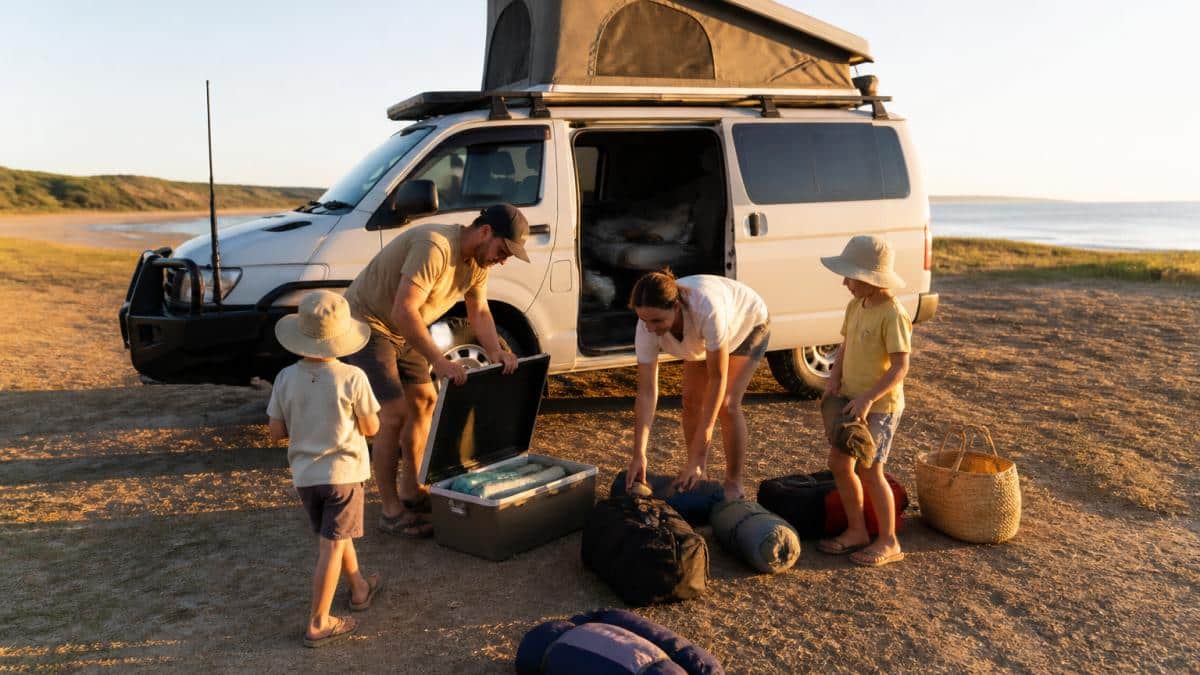
Use this as your decision framework:
| Family setup | What to prioritise | What to watch |
|---|---|---|
| Two adults, two young children | Fixed beds, easy interior access, anchor points confirmed | Storage once beds are made |
| Two adults, two teenagers | Separate sleeping zones, standing height, seating comfort | Passenger space on long driving days |
| Two adults, three children | Seatbelt count plus anchor points, roof or external storage | Sleeping capacity vs. seating capacity |
| Mixed ages with a toddler | Fitted restraint, low step height, shade and ventilation | Setup time at camp each night |
The real difference between a 2WD and 4WD camper for a family of four is where you want to go.
Ask one question before choosing: are we sleeping in the vehicle every night, or using it as a base with occasional cabin nights? Families who mix the two can often size down.
What a Family-Friendly Fleet Should Include
A family-friendly fleet should include confirmed child restraint anchor points, beds that don’t need rebuilding nightly, a working kitchen, and enough storage that the cabin stays usable when beds are made. Everything else is a bonus.
Check these before you commit:
- Vehicle age and service history. Ask directly. A well-maintained older vehicle beats a neglected new one.
- Roadside assistance. Confirm what’s covered and what the response time looks like in remote areas.
- Support access. A number that works outside business hours, and ideally support in your own language if you’re visiting from overseas.
What most guides miss: support quality matters more the further you go. On the coast, a breakdown is an inconvenience; two hundred kilometres inland, it’s the whole trip.
Ask what happens if your plans change mid-trip. Providers who can adjust a one-way drop-off or shift your dates without punishing fees are worth more than a slightly lower daily rate.
Campervan Family Road Trip Itinerary for Western Australia
A campervan family road trip itinerary in Western Australia works best planned around driving time, not distance.
Leg 1: Pickup and a soft start (Day 1)
Collect the vehicle mid-morning and drive south to a campground within an hour or two of the city.
Leg 2: South-west coast and forest country (Days 2-5)
Break the drive south into two shorter legs. Family-friendly campgrounds here typically offer powered sites, camp kitchens, laundry and playgrounds, which matter more than a waterfront view with small children. Plan one rest day: a cave tour, a calm swimming beach and a short forest walk are enough without over-scheduling.
Leg 3: Coastal hop north (Days 6-10)
Return north over several days, keeping each leg to three hours or less. Look for campgrounds with swimming areas, shade and camp kitchens. This is where a buffer day pays for itself: if a child is unwell or the weather turns, you lose a beach morning rather than a whole leg.
Leg 4: Optional northern extension (one week or more)
The reef and gorge country to the north is a serious drive from the south-west.
Practical notes for families
- Check park entry requirements before you go; a park pass saves time at entry stations.
- Build in buffer days, family travel runs slower than planned, and a buffer turns a stressful catch-up drive into an extra beach morning.
- Book campgrounds with camp kitchens and laundry every few nights, not every night.
- Plan around nap times: a leg starting after lunch often means a sleeping toddler and a quieter afternoon.
Don’t schedule long driving days back to back. Heat, fatigue and remote fuel stops compound quickly. Plan fuel and water for each leg, and never assume the next town has what you need.
Ask your provider for a route plan that matches your children’s ages.
Realistic Trip Costs and Booking Tips
Realistic trip costs depend on season, rental duration, vehicle type and how you camp. Rather than quote figures that won’t match your dates, here’s the cost structure to budget from, and where families most often underestimate.
Your total will be built from:
- Daily rate, which moves with seasonality and how far ahead you book. School holidays and the winter south-west peak are when family-sized vehicles tighten first.
- Duration discounts: longer rentals usually lower the per-day cost, so a two-week booking often costs less per day than a one-week booking of the same vehicle.
- One-way fees, if you drop off somewhere other than pickup. These vary by distance and are worth pricing before you commit to a loop.
- Insurance and excess reduction, which is optional but worth pricing in. Read the excess figure and what voids cover, especially on unsealed roads.
Where families underestimate
- The first and last night. An out-of-hours pickup or an early drop-off can add a night’s accommodation before you’ve driven anywhere.
- Water and gas refills. Small, but they add up over a two-week trip if you are not refilling at campgrounds.
- Laundry and camp kitchen use. Some parks charge for machines; budget a small amount per week.
- Restaurant meals on driving days. The convenience stop is where the food budget quietly doubles.
Booking tips that actually change the outcome
- Book early for school holidays. Availability tightens first on family-sized vehicles, not the cheapest ones.
- Compare total cost, not daily rate. A cheaper rate with a large one-way fee and no free cancellation often costs more.
- Confirm cancellation terms in writing. Free cancellation windows vary, and family plans change.
- Ask about unlimited mileage. On a long loop, kilometre caps can quietly blow the budget.
For current rates and a quote matched to your dates, check directly with us rather than relying on generic online figures.
Build your budget from the total trip, not the daily rate. The families who stay on budget are the ones who priced fuel, camp fees and one-way fees before they booked, not after.
Family Campervan Packing List
A family campervan packing list should cover three categories: safety, sleep, and the small things that prevent daily friction. Pack for the vehicle you’ve booked, not the one you wish you’d booked.
Safety and documents
- Driver’s licence and booking confirmation
- Child restraints confirmed, or your own seats if bringing them
- Basic first aid kit and any prescriptions
- Sun protection: hats, sunscreen, long sleeves (Be SunSmart)
Sleep and comfort
- Sleeping bags or linen, if not included
- Pillows and one comfort item per child
- Eye masks or spare sheets for light sleepers
- Torches or head torches for each person
Kitchen and daily life
- Reusable water bottles for everyone
- Compact cooking gear, if not supplied
- Washing-up kit and bin bags
- Wet wipes and a small drying line
Clothing and gear
- Layers, because inland nights get cold even in warm months
- Swimwear and quick-dry towels
- Closed shoes for gorge walks and flip-flops for camp
- A small daypack for stops
The item families forget most often is shade. A compact awning or shade cloth changes how long you can comfortably stay at a camp during the middle of the day.
Conclusion
The hard part of a family campervan trip isn’t the driving. It’s matching the vehicle to your family, getting the restraints right, and planning days that don’t exhaust everyone by the second afternoon.
At Bonito Camper, we’re a family-owned operation in Perth with well-equipped 4WD and 2WD vehicles, long-range fuel tanks for fewer stops, flexible one-way drop-off locations, and a complimentary park pass for unlimited entry to Western Australia’s parks.
Enquire now and we’ll put together a plan for your family trip.
Frequently Asked Questions
Can children travel in a campervan in Western Australia?
Yes, provided every child is correctly restrained. Australian road rules require children under seven to use an approved child restraint or booster seat, and children under four cannot sit in the front seat of a vehicle with two or more rows. When booking family campervan hire, confirm the vehicle has the right anchor points and that the restraint suits your child’s age and size. Ask the rental company to fit the seat before pickup so you can check the installation yourself.
How many people can sleep in a campervan?
Sleeping capacity depends on the model, not the seat count. Many four-berth campervans seat four but sleep two adults and two children comfortably, while larger motorhomes sleep four to six. For a family of four, look for a vehicle with a fixed bed plus a convertible dinette, and check bed dimensions rather than trusting the berth number. If you are booking campervan hire for 4 people on a longer trip, a slightly larger layout usually pays off in comfort.
How much does it cost to hire a family campervan?
Pricing depends on the vehicle, rental duration, season and pickup location, so there is no single figure. School holidays and peak periods cost more than shoulder season, and longer hires usually lower the daily rate. Ask for a full quote that includes insurance excess options, child seat fitting and any one-way fees. Request current rates directly from the rental company rather than relying on older online figures, and budget extra for fuel, campground fees and park entry passes.
How far in advance should I book a campervan for a family holiday?
For school holidays, book as early as your plans allow, ideally several months ahead, because family-sized vehicles with child seat fittings are the first to go. Outside peak periods, a few weeks is often enough, but availability tightens around long weekends and the dry season in the north. If your dates are fixed, reserve early and confirm cancellation terms. Booking ahead also gives you time to compare layouts and ask about child restraints before stock runs low.
