
Table of Contents
- Is 4WD Essential for Karijini? The Short Answer
- Karijini 2WD Access: Where You Can Actually Drive
- Karijini Road Conditions: What to Expect on the Ground
- Which Roads and Attractions Genuinely Need a 4WD
- Karijini 4WD Tracks Worth Planning For
- Vehicle Preparation, Tyre Pressure and Hire Restrictions
- Building a Karijini National Park Itinerary Around Your Vehicle
- Conclusion
- Frequently Asked Questions
Last Updated: October 21, 2026
Is 4WD Essential for Karijini? The Short Answer
So is 4WD essential for Karijini? No. Most visitors reach the park’s main attractions, the visitor centre and the campgrounds in an ordinary two-wheel-drive car, provided they drive to the conditions and check road status first.
This guide from Bonito Camper breaks down exactly which roads you can drive in 2WD and which ones genuinely call for a high-clearance vehicle.
Karijini sits in the Pilbara, roughly 1,400 km north of Perth. The bitumen highway gets you to the park’s edge without drama. Beyond that, the picture changes fast: unsealed roads, corrugations and rocky sections appear the moment you leave the highway.
So the real question isn’t whether you need a 4WD. It’s whether your specific route and your specific vehicle match.
Below, we’ll show you a road-by-road breakdown so you can plan with confidence.
For most travellers, a 2WD handles the main sealed roads and the visitor centre. A 4WD opens up the rougher tracks, the gorges with unsealed access and the remote camping areas.
Karijini 2WD Access: Where You Can Actually Drive
Two-wheel-drive access to Karijini is better than many travellers expect, but it is not uniform.
| Road or access point | Surface | 2WD suitability | Notes |
|---|---|---|---|
| Great Northern Highway to the park turn-offs | Sealed | Yes | Reliable year-round; the main approach from Tom Price and Newman |
| Banjima Drive (the main park road linking the visitor centre and campground) | Sealed and formed gravel | Yes in dry conditions | The backbone of a 2WD visit; watch for corrugations on gravel stretches |
| Access to the visitor centre | Sealed | Yes | Start here for current road status and ranger advice |
| Access to the main campground and eco retreat | Formed gravel | Yes in dry conditions | Fine when graded; can soften after rain |
| Dales Gorge and Fortescue Falls car park | Sealed and formed gravel | Yes in dry conditions | The most 2WD-friendly of the headline gorges |
| Weano Gorge and Hancock Gorge car parks | Formed gravel | Usually yes in dry conditions | Clearance is fine; traction is the limiting factor when wet |
| Joffre Gorge lookout and car park | Formed gravel | Usually yes in dry conditions | Short gravel approach; check grading after heavy use |
| Knox Gorge car park | Formed gravel | Usually yes in dry conditions | Same caveat as the other gorge car parks |
| Hamersley Gorge access | Gravel | Marginal | Rougher and more remote; high clearance is an advantage |
| Karijini Drive and other through-routes | Mixed unsealed | No | Corrugated, rocky and remote; not a 2WD route |
Three practical rules follow from that table.
First, the sealed and formed-gravel spine gets a 2WD to the visitor centre, the main campground and the car parks for Dales, Weano, Hancock, Joffre and Knox gorges. That covers the headline attractions for most visitors.
Second, “formed gravel” is not the same as “sealed.” Grading varies through the season, corrugations build up between passes, and a road that was smooth in June can be rough by September.
Third, the moment a road turns to unsealed track, a 2WD’s lack of clearance and traction becomes the deciding factor. Low-profile tyres, limited ground clearance and no low-range gearing all work against you on rocky, rutted or wet surfaces.
A common mistake is assuming “accessible” means “accessible in any weather.” A formed gravel road that is fine in the dry can turn slick and impassable after rain, and the park can close sections at short notice.
A 2WD reaches the visitor centre, the main campground and the car parks for Dales, Weano, Hancock, Joffre and Knox gorges on sealed and formed gravel roads in dry conditions. It does not belong on the park’s unsealed through-routes or rough tracks.
Karijini Road Conditions: What to Expect on the Ground
Karijini road conditions vary sharply between sealed and unsealed sections, and between seasons. The bitumen is smooth and predictable. The dirt and gravel roads are where your vehicle and your driving skill get tested.
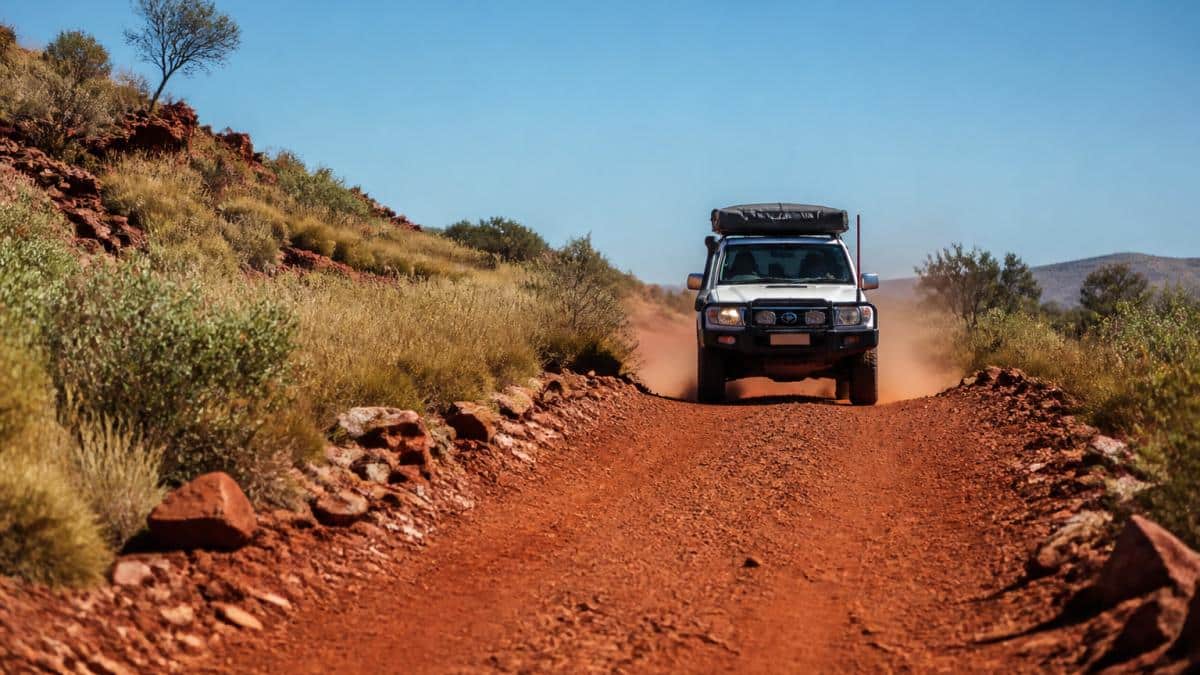
Expect these features on the unsealed sections:
- Corrugations that shake a vehicle and loosen fittings
- Loose gravel that reduces grip on corners
- Rocky patches and uneven surfaces
- Dust that limits visibility when another vehicle passes
Rain changes everything. Wet dirt roads become slippery and can trap a 2WD in minutes. Seasonal conditions matter, so check closures and roadworks before you set out. The parks authority road updates for Karijini are the place to start.
Which Roads and Attractions Genuinely Need a 4WD
Some routes and attractions genuinely require a 4WD or a high-clearance vehicle. These are the spots where a standard car shouldn’t go, no matter how confident the driver feels.
The roads that typically call for 4WD or high clearance include:
- Unsealed access tracks to the more remote gorges
- Routes with rocky terrain and steep, uneven sections
- Tracks leading to remote camping areas
- Any unsealed road after significant rain
For these, a 2WD simply lacks the clearance and traction. Ground clearance matters most: a low car can bottom out on rocks and ruts that a high-clearance vehicle rolls over.
If your heart is set on the remote gorges and the quieter swimming holes, plan around a 4WD. If you’re happy with the main attractions, a 2WD keeps your options open.
Taking a 2WD onto a track marked for 4WD risks more than a tow bill. You can damage the vehicle, void your hire cover and put yourself in a genuinely remote spot with no phone signal.
Karijini 4WD Tracks Worth Planning For
For travellers who want the full experience, the 4WD tracks are the reward, but they are also where vague advice gets people into trouble.
| Route or area | Why it needs 4WD or high clearance | What it opens up |
|---|---|---|
| Karijini Drive and the park’s unsealed through-routes | Long stretches of corrugated, rocky and remote unsealed road | A loop through the park rather than an out-and-back on the sealed spine |
| Hamersley Gorge access | Rougher gravel and a more remote approach | One of the park’s most striking gorges, with banded rock formations |
| Remote gorge access tracks off the main road | Rocky terrain, steep and uneven sections, limited passing room | Quieter gorges and trailheads away from the main car parks |
| Tracks to remote camping areas | Unsealed surfaces, no facilities, long distances between help | Dispersed camping away from the main campground |
| Any unsealed road after significant rain | Slippery clay surfaces, bogging risk, possible closures | Nothing worth the risk; wait for the road to dry and reopen |
A 4WD buys you three things on these routes: clearance to roll over rocks and ruts that would stop a low car, traction to keep moving on loose gravel and wet clay, and range to carry enough fuel and water for the longer distances between services.
The trade-off is real. These tracks demand lower tyre pressure, slower speeds, a vehicle you trust and a driver who knows when to turn back. Corrugations loosen fittings, rocky sections can damage sumps and tyres, and phone signal is unreliable or absent.
If your heart is set on the remote gorges and the quieter swimming holes, plan around a 4WD and build slack into the itinerary. If you are happy with the main attractions, a 2WD keeps your options open and your costs down.
Before committing to any unsealed route, ask two questions: does my hire agreement allow it, and has the road been graded or reopened since the last rain? A two-minute check at the visitor centre can save a very long day.
Vehicle Preparation, Tyre Pressure and Hire Restrictions
Vehicle preparation separates a smooth Karijini trip from a stressful one. Tyre pressure and hire restrictions are the two things travellers most often overlook.
Start with tyre pressure. On unsealed roads, lowering tyre pressure improves grip and softens the ride over corrugations. Air back up before you return to the bitumen.
Here’s a practical pre-trip checklist:
- Confirm your hire agreement allows unsealed-road driving
- Check the spare tyre and the jack are present and working
- Carry a tyre pressure gauge and a way to inflate
- Pack extra food, water and fuel for remote sections
- Download offline maps before you lose signal
- Confirm fuel availability and plan your stops
Hire restrictions deserve special attention. Many rental agreements limit or exclude unsealed-road use, and some exclude 4WD tracks entirely. Check the fine print and your insurance cover before you book.
At Bonito Camper, our vehicles are set up for remote travel, with long-range fuel tanks for fewer fuel stops. We’ll walk you through what your chosen vehicle can and can’t do.
If you’re unsure whether your route counts as “unsealed,” ask before you book. A two-minute question at pickup beats a dispute at drop-off.
Building a Karijini National Park Itinerary Around Your Vehicle
Your Karijini National Park itinerary should match your vehicle, not the other way around. Build the plan around what you can actually reach, then add the rest as options.
For a 2WD trip, anchor your days on the sealed network, the visitor centre and the main gorges. Keep travel time realistic and leave buffer for road conditions.
For a 4WD trip, layer in the remote tracks, the quieter campgrounds and the swimming holes. Plan fuel, water and food around the longer distances.
| Vehicle | Best For | Watch Out For |
|---|---|---|
| 2WD | Main gorges, visitor centre, sealed routes | Unsealed roads, wet weather |
| High-clearance 2WD | Light gravel in dry conditions | Rocky tracks, remote access |
| 4WD | Remote gorges, tracks, quiet camps | Tyre pressure, hire restrictions |
Route planning around travel time is where most itineraries fall apart. Distances look short on a map but take longer on dirt. Build in slack, and check closures and roadworks before each day’s drive.
If you’d rather not plan it all yourself, our team can help shape a route that fits your vehicle and your pace.
Conclusion
The honest answer to whether a 4WD is essential for Karijini is that it depends on your route. For the main attractions and sealed roads, a 2WD does the job. For the remote gorges, tracks and quiet camps, a 4WD earns its place.
Getting the vehicle right is the difference between a relaxed trip and a stressful one. At Bonito Camper, we offer well-equipped 4WD and 2WD vehicles, long-range fuel tanks for fewer fuel stops, and a complimentary park pass for unlimited entry to Western Australia’s parks. Our family-owned team knows these roads and will help you plan around them.
Get started with Bonito Camper and drive Karijini with the right vehicle and a plan that fits.
Frequently Asked Questions
Can you drive to Karijini in a 2WD?
Yes, you can reach the park’s main visitor centre and several gorges in a 2WD via sealed and improved roads. The Great Northern Highway and the Banjima Drive access road are bitumen or well-graded gravel suitable for most vehicles. What limits 2WD access is not getting to Karijini, but reaching specific trailheads and gorge car parks on rougher unsealed sections. Check Karijini road conditions before you travel, as rain can close unsealed roads quickly.
Do you need a 4WD to reach Karijini’s gorges?
Some gorges are reachable in a 2WD, while others need high clearance or a 4WD. Dales Gorge and the visitor centre area are generally accessible in a 2WD. Weano Gorge and Hancock Gorge sit at the end of an unsealed road that becomes rough and rocky after rain, so a high-clearance vehicle is safer. For the most remote sections and Karijini 4WD tracks, low-range gearing and decent ground clearance make the difference between a comfortable drive and a risky one.
What are the Karijini road conditions like inside the park?
Inside the park you will mix bitumen, graded gravel and rough rocky sections. The main access roads are usually fine for most vehicles in dry weather, but unsealed roads deteriorate fast after rain, with washouts and slippery surfaces. Lower your tyre pressure slightly on gravel for better grip, carry water and food, and check for closures before setting out. Phone signal is patchy, so plan your route and tell someone your itinerary before you leave the visitor centre.
Do you have to pay to enter Karijini National Park?
Yes, Karijini National Park charges a park entry fee for vehicles, payable at the visitor centre or online through the state parks service. Some rental companies include a park pass with your booking, which covers unlimited entry to Western Australian parks and saves you paying at each gate. Confirm what your hire includes before you travel, and budget for the fee if your vehicle does not come with a pass.